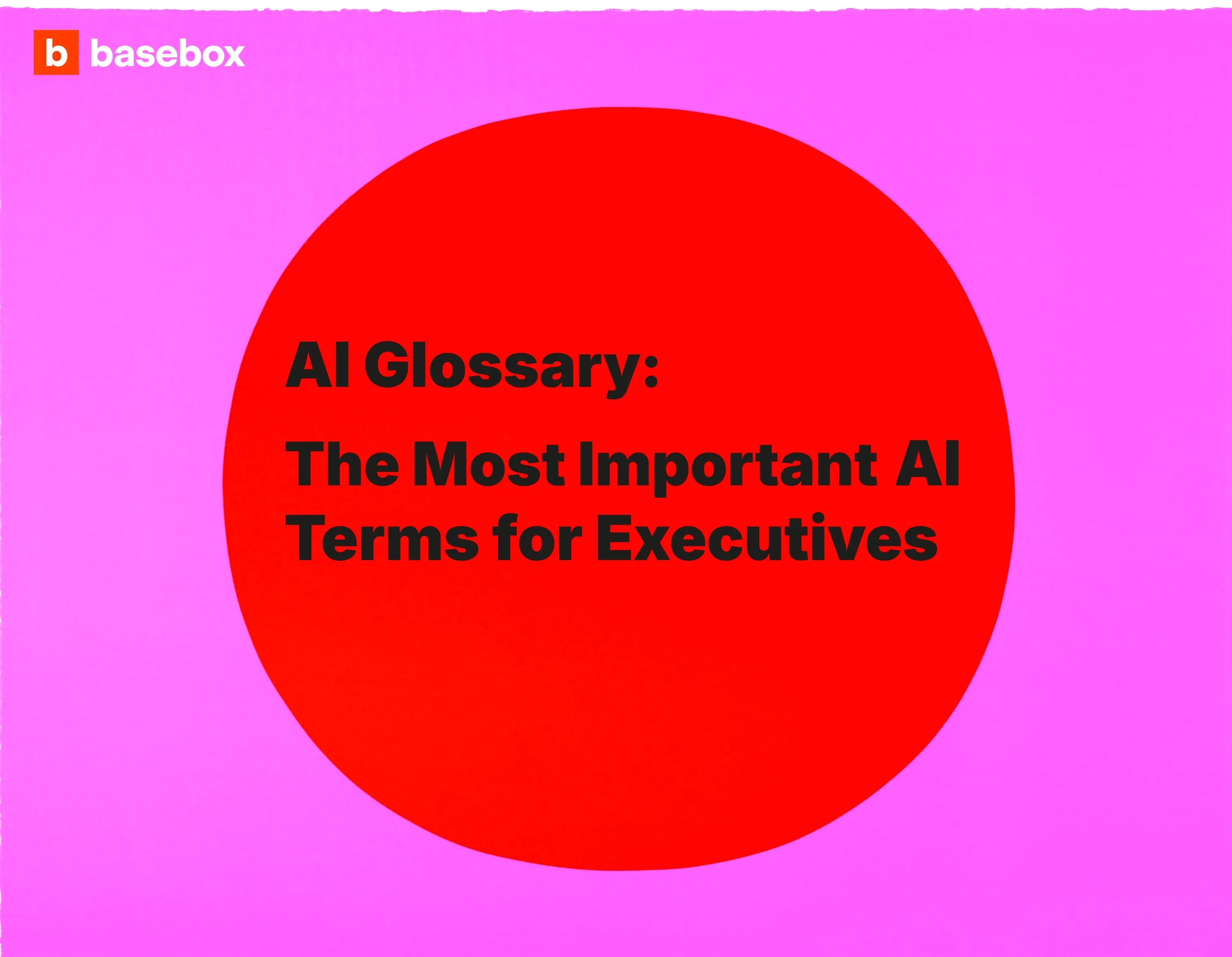
Führungskräfte bewerten AI-Initiativen und schulen ihre Teams – dabei hilft ein gemeinsames Fachvokabular. Komplexe AI-Begriffe werden oft inkonsistent verwendet oder falsch verstanden, was zu Missverständnissen in Projekten und ineffektiven Entscheidungen führt.
Unser praxisorientierter AI-Glossar erklärt die wichtigsten Begriffe der Künstlichen Intelligenz verständlich und managementrelevant, damit Sie fundierte Entscheidungen treffen und Ihr Team erfolgreich in die AI-Transformation führen können.
Laden Sie unser kostenloses AI-Glossar als PDF herunter und teilen es mit Ihrem Team für eine gemeinsame Wissensbasis.
-
A/B Testing - Methode zum Vergleich verschiedener Modellversionen in realen Anwendungen durch systematische Tests mit unterschiedlichen Nutzergruppen.
-
Accuracy - Genauigkeitsmetrik, die den Anteil korrekt klassifizierter Vorhersagen an der Gesamtzahl der Vorhersagen misst.
-
Adversarial Learning - Ein Trainingsansatz, bei dem Modelle gegen speziell entwickelte “Angriffe” oder störende Eingaben robust gemacht werden. Ziel ist es, die Sicherheit und Zuverlässigkeit von KI-Systemen zu verbessern.
-
Agentive (Agenten) - Systeme oder Modelle, die eine eigene Handlungsfähigkeit (Agency) aufweisen, um autonom Ziele zu verfolgen. Ein agentives Modell kann ohne ständige Überwachung agieren, wie zum Beispiel ein hochautonomes Fahrzeug.
-
AGI (Artificial General Intelligence) - Eine hypothetische Form der KI, die menschliche kognitive Fähigkeiten in allen Bereichen erreicht oder übertrifft und sich selbstständig weiterentwickeln kann. AGI existiert derzeit noch nicht.
-
AI (Artificial Intelligence)/KI (Künstliche Intelligenz) - Ein Teilgebiet der Informatik, das sich mit der Entwicklung von Systemen beschäftigt, die Aufgaben ausführen können, die normalerweise menschliche Intelligenz erfordern, wie Lernen, Problemlösung und Mustererkennung.
-
AI Ethics - Prinzipien und Richtlinien, die darauf abzielen, Schäden durch KI für Menschen zu verhindern. Umfasst Themen wie Fairness, Transparenz, Verantwortlichkeit und den verantwortungsvollen Umgang mit Daten und Algorithmen.
-
AI Governance - Ein strukturiertes Rahmenwerk aus Richtlinien, Prozessen und Kontrollen zur verantwortungsvollen Entwicklung, Implementierung und Überwachung von KI-Systemen in Organisationen.
AI Governance umfasst die strategische Steuerung aller KI-Aktivitäten eines Unternehmens. Dazu gehören Risikobeurteilung, Compliance-Management, ethische Leitlinien, Datenqualitätsstandards und Verantwortlichkeiten. Ein typisches AI Governance Framework definiert Rollen (AI Ethics Board, Data Stewards), Prozesse (Modell-Approval, Monitoring) und Standards (Fairness-Metriken, Dokumentation). Ziel ist es, KI-Risiken zu minimieren, regulatorische Anforderungen zu erfüllen und Vertrauen in KI-Systeme aufzubauen, während Innovation gefördert wird.
-
AI Management System - Umfassende Plattform zur zentralen Verwaltung und Orchestrierung von KI-Projekten im gesamten Lebenszyklus. Ein AI Management System koordiniert Datenflüsse, Modellentwicklung, Deployment und Monitoring, während es gleichzeitig Governance-Richtlinien durchsetzt und Compliance sicherstellt.
-
AI Safety - Ein interdisziplinäres Forschungsfeld, das sich mit den Risiken und langfristigen Auswirkungen von KI befasst. Untersucht sowohl kurzfristige Probleme wie Bias als auch langfristige Szenarien wie die mögliche Entwicklung einer Superintelligenz.
-
AI Stack - Technologische Architektur aus aufeinander aufbauenden Software-Schichten, die zusammen eine vollständige KI-Entwicklungsumgebung bilden. Der AI Stack umfasst typischerweise die Datenebene (Preprocessing, Feature Engineering), Framework-Layer (TensorFlow, PyTorch), Modell-Management-Schicht, API-Layer für Deployment und die Anwendungsebene - eine integrierte Umgebung die diese Komponenten nahtlos orchestriert und eine einheitliche Plattform für den gesamten ML-Workflow bietet.
-
Air Gapped - Ein Sicherheitskonzept, bei dem KI-Systeme physisch von externen Netzwerken getrennt sind, um unbefugten Zugriff oder Datenabfluss zu verhindern.
-
Alignment - Das Anpassen einer KI, sodass ihre Ziele und ihr Verhalten mit menschlichen Werten und Absichten übereinstimmen. Dies umfasst sowohl technische Aspekte wie Inhaltsmoderation als auch philosophische Fragen über gewünschte Ergebnisse.
-
Algorithmus/Algorithm - Eine Reihe von mathematischen Anweisungen und Regeln, die einem Computer ermöglichen, spezifische Probleme zu lösen oder Aufgaben auszuführen. In der KI bilden Algorithmen die Grundlage für das Lernen aus Daten.
-
Algorithmic Accountability - Verantwortlichkeit für die Entscheidungen und Auswirkungen von Algorithmen, einschließlich der Transparenz über deren Funktionsweise und der Rechenschaftspflicht für deren Ergebnisse.
-
Anthropomorphism - Die menschliche Tendenz, nicht-menschlichen Objekten menschliche Eigenschaften, Emotionen oder Bewusstsein zuzuschreiben. In der KI führt dies oft dazu, dass Menschen Chatbots als empfindungsfähig wahrnehmen.
-
API (Application Programming Interface) - Schnittstellen, über die verschiedene Software-Anwendungen mit KI-Modellen kommunizieren können.
-
Attention Mechanism - Eine Technik in neuronalen Netzwerken, die es Modellen ermöglicht, sich auf relevante Teile der Eingabedaten zu konzentrieren, anstatt alle Informationen gleichmäßig zu gewichten.
-
Autoencoder - Neuronale Netzwerke, die Daten komprimieren und rekonstruieren, oft für Dimensionsreduktion oder Anomalieerkennung verwendet.
-
Automation/RPA (Robotic Process Automation) - Technologie zur Automatisierung repetitiver, regelbasierter Geschäftsprozesse durch Software-“Roboter”, die menschliche Aktionen in digitalen Systemen nachahmen. RPA automatisiert strukturierte Aufgaben wie Dateneingabe, Berichterstellung oder E-Mail-Verarbeitung ohne Änderung bestehender IT-Systeme. In Kombination mit KI (Intelligent Process Automation) können auch unstrukturierte Daten verarbeitet und komplexere Entscheidungen getroffen werden. RPA bietet schnelle Implementierung, hohe Genauigkeit und 24/7-Verfügbarkeit bei geringen Anfangsinvestitionen.
-
Autonomous Agents - KI-Systeme, die selbstständig in ihrer Umgebung agieren können, um bestimmte Ziele zu erreichen. Sie verfügen über Sensoren zur Wahrnehmung, Entscheidungsalgorithmen und Aktoren zur Ausführung von Handlungen.
-
Backpropagation - Der Algorithmus, mit dem neuronale Netzwerke lernen, indem Fehler rückwärts durch das Netzwerk propagiert werden.
-
Basismodelle - Siehe Foundation Models.
-
Benchmark - Standardisierte Tests zur Bewertung und zum Vergleich von KI-Modellen anhand einheitlicher Kriterien.
-
BERT - Bidirectional Encoder Representations from Transformers; einflussreiches Sprachmodell von Google, das bidirektionale Kontextverarbeitung ermöglicht.
-
Bias - Systematische Verzerrungen in KI-Modellen, die zu unfairen oder diskriminierenden Ergebnissen führen können. Entstehen meist durch unausgewogene oder vorurteilsbehaftete Trainingsdaten.
-
Bias Mitigation - Strategien und Techniken zur Identifizierung, Messung und Reduzierung von Vorurteilen in KI-Systemen, um fairere Ergebnisse zu erzielen.
-
Big Data - Extrem große und komplexe Datensätze, die spezielle Technologien und Methoden zur Verarbeitung, Speicherung und Analyse erfordern. Oft charakterisiert durch die “5 V’s”: Volume, Velocity, Variety, Veracity und Value.
-
Chain of Thought - Technik, bei der KI-Modelle ihre Denkschritte explizit darlegen, um nachvollziehbare Problemlösungen zu entwickeln.
-
Chatbot - Ein Computerprogramm, das natürlichsprachliche Konversationen mit Menschen führen kann, typischerweise über Text- oder Sprachschnittstellen.
-
ChatGPT - Ein von OpenAI entwickelter konversationeller KI-Assistent, der auf der GPT-Architektur (Generative Pre-trained Transformer) basiert und für dialogorientierte Anwendungen optimiert wurde.
-
Cloud - Ein Modell für die Bereitstellung von IT-Ressourcen über das Internet, das es ermöglicht, KI-Dienste und -Infrastrukturen flexibel und skalierbar zu nutzen.
-
Clustering - Eine unüberwachte Lernmethode, die ähnliche Datenpunkte automatisch in Gruppen (Cluster) organisiert, ohne dass vorab bekannt ist, welche Gruppen existieren sollten. Clustering-Algorithmen wie K-Means oder hierarchisches Clustering finden versteckte Muster und Strukturen in Daten. Anwendungen umfassen Kundensegmentierung, Marktforschung, Anomalieerkennung und Empfehlungssysteme. Der Algorithmus bestimmt selbstständig, welche Datenpunkte ähnlich sind und gruppiert sie entsprechend. Dies ermöglicht Erkenntnisse über natürliche Datenstrukturen ohne menschliche Vorgaben.
-
Cognitive Computing - Ein Ansatz zur KI, der darauf abzielt, menschliche Denkprozesse zu simulieren, einschließlich Lernen, Schlussfolgern und Selbstkorrektur.
-
Computer Vision (CV) - Der Bereich der KI, der sich mit der Interpretation und Analyse visueller Daten beschäftigt.
-
Constitutional AI - Ansatz zur Entwicklung von KI-Systemen mit eingebauten ethischen Prinzipien und Werten.
-
Continual Learning - Fähigkeit von Modellen, kontinuierlich neue Aufgaben zu lernen, ohne alte Kenntnisse zu vergessen.
-
Conversational AI - KI-Systeme, die darauf spezialisiert sind, natürliche Gespräche mit Menschen zu führen, oft durch Chatbots oder Sprachassistenten.
-
Convolutional Neural Networks (CNNs) - Eine spezialisierte Architektur neuronaler Netzwerke, die besonders effektiv für die Verarbeitung von Bilddaten ist. CNNs verwenden Faltungsoperationen, um lokale Muster und Merkmale in Bildern zu erkennen.
-
Cross-Validation - Eine Methode zur Bewertung der Modellleistung durch systematische Aufteilung der Daten in Trainings- und Testsets.
-
Data Augmentation - Techniken zur künstlichen Erweiterung von Trainingsdatensätzen durch Transformationen bestehender Daten (z.B. Rotation, Skalierung von Bildern), um die Modellleistung zu verbessern.
-
Data Governance - Richtlinien und Prozesse für das Management von Daten in KI-Projekten.
-
Data Labeling - Prozess der Annotation von Daten mit korrekten Antworten oder Kategorien für Supervised Learning.
-
Data Mining - Der Prozess der Entdeckung von Mustern und Erkenntnissen in großen Datensätzen mithilfe statistischer und maschineller Lernmethoden.
-
Data Pipeline - Automatisierte Abfolge von Datenverarbeitungsschritten von der Quelle bis zum Modell.
-
Daten - Die Grundlage für KI-Systeme; strukturierte oder unstrukturierte Informationen, die zur Schulung und zum Betrieb von Algorithmen verwendet werden.
-
Datenschutz und Datensicherheit (Data Privacy) - Schutz persönlicher Daten in KI-Systemen.
-
Decision Trees - Ein interpretierbares Machine Learning-Modell, das Entscheidungsregeln in einer baumartigen Struktur darstellt. Jeder Knoten repräsentiert eine Entscheidung basierend auf einem Merkmal, was zu nachvollziehbaren Entscheidungspfaden führt.
-
Deep Learning - Ein Teilbereich des maschinellen Lernens, der tiefe neuronale Netzwerke mit vielen Schichten verwendet, um komplexe Muster in großen Datenmengen zu erkennen und zu lernen.
-
Diffusion Models - Eine Klasse generativer Modelle, die lernen, Daten zu erzeugen, indem sie einen Prozess umkehren, der schrittweise Rauschen zu Daten hinzufügt. Besonders erfolgreich in der Bildgenerierung.
-
Dimensionality Reduction - Techniken zur Reduzierung der Anzahl von Merkmalen in Datensätzen, um Komplexität zu verringern und Visualisierung zu ermöglichen.
-
Dropout - Regularisierungstechnik in neuronalen Netzwerken zur Vermeidung von Overfitting durch zufälliges Deaktivieren von Neuronen während des Trainings.
-
DSGVO - Die Datenschutz-Grundverordnung der EU, die den Schutz personenbezogener Daten regelt und wichtige Auswirkungen auf KI-Systeme hat.
-
Edge AI - KI-Verarbeitung direkt auf Endgeräten statt in der Cloud.
-
Embedding - Numerische Repräsentationen von Wörtern, Bildern oder anderen Daten in einem mehrdimensionalen Raum, die semantische Beziehungen erfassen.
-
Emergent Behavior - Unerwartete Fähigkeiten oder Verhaltensweisen, die in KI-Modellen auftreten, ohne explizit programmiert oder trainiert worden zu sein. Entstehen durch komplexe Interaktionen in großen Modellen.
-
End-to-End Learning - Ein Ansatz im Deep Learning, bei dem ein Modell eine komplette Aufgabe von der Roheingabe bis zur finalen Ausgabe in einem einzigen, integrierten System lernt.
-
Ende-zu-Ende Verschlüsselung - Ein Sicherheitsverfahren, bei dem Daten während der gesamten Übertragung verschlüsselt bleiben und nur von den beabsichtigten Empfängern entschlüsselt werden können.
-
Ensemble Methods - Kombination mehrerer Modelle für bessere Vorhersagen.
-
Epoch - Ein vollständiger Durchlauf durch alle Trainingsdaten während des Modelltrainings.
-
Ethical Considerations - Die systematische Berücksichtigung moralischer und gesellschaftlicher Auswirkungen von KI-Systemen, einschließlich Datenschutz, Fairness und potenziellem Missbrauch.
-
EU AI Act - Die EU-Verordnung zur Regulierung von KI-Systemen, die Risikokategorien definiert und entsprechende Anforderungen festlegt.
-
Explainable AI (XAI) - KI-Systeme und -Methoden, die ihre Entscheidungsprozesse transparent und für Menschen verständlich machen können.
-
F1-Score - Harmonisches Mittel aus Precision und Recall zur ausgewogenen Bewertung von Klassifikationsmodellen.
-
Fairness - Sicherstellung, dass KI-Systeme alle Gruppen gleich behandeln.
-
Feature Engineering - Prozess der Auswahl und Transformation von Eingabemerkmalen für bessere Modellleistung.
-
Federated Learning - Verteiltes Lernen, bei dem Modelle auf dezentralen Daten trainiert werden, ohne dass die Rohdaten zentral gesammelt werden müssen.
-
Few-Shot Learning - Die Fähigkeit eines Modells, mit nur wenigen Beispielen neue Aufgaben zu lernen.
-
Fine-Tuning - Der Prozess der Anpassung eines vortrainierten Modells an spezifische Aufgaben.
-
Foundation Models - Große, vielseitige Modelle, die als Basis für verschiedene Anwendungen dienen können.
-
Generative Adversarial Networks (GANs) - Eine Architektur aus zwei konkurrierenden neuronalen Netzwerken: einem Generator, der neue Daten erstellt, und einem Diskriminator, der echte von generierten Daten unterscheidet.
-
Generative AI - KI-Systeme, die neue Inhalte wie Text, Bilder, Audio oder Code erstellen können, basierend auf Mustern, die sie aus Trainingsdaten gelernt haben.
-
Google Gemini - Googles multimodales KI-Modell, das Text, Bilder und andere Datentypen verarbeiten kann.
-
GPT - Generative Pre-trained Transformer; eine Familie von Sprachmodellen von OpenAI, die auf der Transformer-Architektur basieren.
-
GPU - Graphics Processing Unit; spezialisierte Prozessoren, die besonders effizient für das Training und die Ausführung von KI-Modellen sind.
-
Gradient Boosting - Ensemble-Methode, die schwache Lerner sequenziell kombiniert, um starke Vorhersagemodelle zu erstellen.
-
Gradient Descent - Ein Optimierungsalgorithmus, der verwendet wird, um die Parameter eines Modells zu verbessern.
-
Grounding/Ground Truth - Verifizierte, korrekte Referenzdaten, die als Maßstab für die Bewertung von KI-Modellen dienen.
-
Guardrails - Sicherheitsmechanismen und Richtlinien, die in KI-Systeme implementiert werden, um schädliche, unethische oder unerwünschte Ausgaben zu verhindern.
-
Halluzination/Hallucination - Das Phänomen, bei dem KI-Modelle (besonders Sprachmodelle) Informationen generieren, die faktisch falsch sind, aber überzeugend und plausibel erscheinen.
-
Hosting - Die Bereitstellung von Infrastruktur und Diensten für den Betrieb von KI-Anwendungen.
-
Human-in-the-Loop - Ansatz, bei dem Menschen in den KI-Entscheidungsprozess eingebunden bleiben, um Qualität und Kontrolle zu gewährleisten.
-
Hybride KI - Systeme, die verschiedene KI-Ansätze kombinieren oder KI mit traditionellen Programmierungsmethoden verbinden.
-
Hyperparameter - Konfigurationseinstellungen, die vor dem Training festgelegt werden und das Lernverhalten steuern.
-
In-Context Learning - Lernen durch Beispiele im Prompt, ohne das Modell neu zu trainieren.
-
Inference - Der Prozess, bei dem ein trainiertes KI-Modell Vorhersagen oder Ausgaben für neue, ungesehene Eingabedaten generiert.
-
Integration - Der Prozess der Einbindung von KI-Systemen in bestehende IT-Infrastrukturen und Geschäftsprozesse.
-
Interpretability - Die Fähigkeit, KI-Entscheidungen zu verstehen und zu erklären.
-
IoT - Internet of Things; Netzwerk von physischen Objekten mit eingebetteten Sensoren und Konnektivität, oft in Verbindung mit KI für intelligente Automatisierung.
-
KI-Modell - Ein mathematisches Modell, das durch maschinelles Lernen trainiert wurde, um spezifische Aufgaben auszuführen.
-
KI-System - Ein vollständiges System, das KI-Modelle, Datenverarbeitung, Benutzeroberflächen und andere Komponenten umfasst.
-
Llama - Eine Familie von Open-Source-Sprachmodellen von Meta (ehemals Facebook).
-
LLM (Large Language Model) - Große neuronale Netzwerke, die auf umfangreichen Textdaten trainiert wurden, um menschliche Sprache zu verstehen und zu generieren. Beispiele sind GPT, BERT und LaMDA.
-
Lock-In - Die Abhängigkeit von einem bestimmten Anbieter oder einer Technologie, die den Wechsel zu Alternativen erschwert.
-
Loss Function - Eine mathematische Funktion, die misst, wie weit die Vorhersagen eines Modells von den tatsächlichen Ergebnissen abweichen.
-
LSTM (Long Short-Term Memory) - Spezielle RNN-Architektur für die Verarbeitung langer Sequenzen, die das Problem des verschwindenden Gradienten löst.
-
Machine Learning (ML) - Ein Teilbereich der KI, der Algorithmen und statistische Modelle verwendet, um Computern das Lernen aus Daten zu ermöglichen, ohne explizit für jede Aufgabe programmiert zu werden.
-
MCP - Model Context Protocol; ein Standard für die Kommunikation zwischen KI-Modellen und externen Datenquellen.
-
Microsoft Bing - Microsofts Suchmaschine, die KI-Technologien (insbesondere von OpenAI) integriert hat, um erweiterte Suchfunktionen und konversationelle Antworten zu bieten.
-
Mistral - Ein französisches KI-Unternehmen, das Open-Source-Sprachmodelle entwickelt.
-
Mixture of Experts (MoE) - Architektur, die verschiedene spezialisierte Modelle kombiniert, wobei ein Gating-Netzwerk entscheidet, welche Experten für eine bestimmte Eingabe aktiviert werden.
-
MLOps - Praktiken für die Bereitstellung und Wartung von Machine Learning-Systemen in der Produktion.
-
Model Deployment - Der Prozess der Implementierung trainierter Modelle in produktive Umgebungen.
-
Model Drift - Verschlechterung der Modellleistung über Zeit durch sich ändernde Daten oder Umgebungsbedingungen.
-
Multiagent Systems - Systeme mit mehreren interagierenden KI-Agenten, die zusammenarbeiten oder konkurrieren.
-
Multimodal AI - KI-Systeme, die verschiedene Arten von Eingabedaten (Text, Bilder, Audio, Video) gleichzeitig verarbeiten und verstehen können.
-
MVP (Minimum Viable Product) - Die einfachste Version einer KI-Anwendung, die gerade genug Funktionen enthält, um echten Nutzern Wert zu bieten und Feedback zu sammeln. Ein MVP in KI-Projekten fokussiert sich auf die Kernfunktionalität und wird schnell entwickelt, um frühes Nutzerfeedback zu erhalten. Es enthält nur die wesentlichen Features und wird iterativ basierend auf Nutzererfahrungen verbessert. Dies ermöglicht es, Marktbedürfnisse zu validieren und Entwicklungsrisiken zu minimieren, bevor umfangreiche Ressourcen investiert werden.
-
Neural Architecture Search (NAS) - Automatisierte Suche nach optimalen neuronalen Netzwerkarchitekturen.
-
Neuronale Netze (NN) - Ein Rechenmodell, das von der Struktur des menschlichen Gehirns inspiriert ist und aus miteinander verbundenen Knoten (Neuronen) besteht, die Muster in Daten erkennen und lernen können.
-
NLP (Natural Language Processing) - Ein Teilbereich der KI, der sich mit der Interaktion zwischen Computern und menschlicher Sprache beschäftigt, einschließlich Verstehen, Interpretieren und Generieren natürlicher Sprache.
-
Normalization - Skalierung von Daten auf einheitliche Bereiche für besseres Training und Vergleichbarkeit.
-
Object Detection - Computer Vision-Aufgabe zur Erkennung und Lokalisierung von Objekten in Bildern.
-
On-Prem (On Premises) - IT-Infrastruktur, die lokal in den eigenen Räumlichkeiten eines Unternehmens betrieben wird, im Gegensatz zu Cloud-basierten Lösungen.
-
Open Source - Software, deren Quellcode öffentlich zugänglich ist und frei modifiziert und verteilt werden kann.
-
Optimization - Prozess der Verbesserung von Modellparametern zur Minimierung von Fehlern oder Maximierung der Leistung.
-
Overfitting - Ein Problem im maschinellen Lernen, bei dem ein Modell zu spezifisch auf die Trainingsdaten angepasst wird und dadurch schlecht auf neue, ungesehene Daten generalisiert.
-
Parameters - Numerische Werte in einem Modell, die während des Trainings angepasst werden und das Verhalten und die Vorhersagen des Modells bestimmen.
-
Perplexity - Sowohl eine Metrik zur Bewertung von Sprachmodellen (misst die Unsicherheit bei Vorhersagen) als auch eine KI-gestützte Suchmaschine, die Quellen für ihre Antworten angibt.
-
PoC (Proof of Concept) - Ein kleines, experimentelles Projekt zur Demonstration der Machbarkeit einer KI-Lösung, bevor größere Investitionen getätigt werden. Ein PoC testet die grundsätzliche Funktionsfähigkeit einer KI-Anwendung mit begrenzten Ressourcen und Daten. Ziel ist es, technische Risiken zu identifizieren, erste Leistungskennzahlen zu ermitteln und Stakeholder von der Viabilität zu überzeugen. PoCs dauern typischerweise 4-12 Wochen und verwenden einen kleinen Datensatz. Sie helfen bei der Entscheidung, ob ein Projekt in die Pilotphase oder Vollentwicklung übergeht.
-
Precision und Recall - Metriken zur Bewertung der Qualität von Klassifikationsmodellen. Precision misst die Genauigkeit positiver Vorhersagen, Recall die Vollständigkeit der erkannten positiven Fälle.
-
Predictive Analytics - Verwendung von Daten und Algorithmen zur Vorhersage zukünftiger Ereignisse.
-
Preprocessing - Vorbereitung und Bereinigung von Rohdaten vor dem Training oder der Analyse.
-
Privatsphäre - Der Schutz persönlicher Informationen und die Kontrolle darüber, wie diese Daten gesammelt und verwendet werden.
-
Prompt - Die Eingabe (Text, Frage oder Anweisung), die einem KI-Modell gegeben wird, um eine gewünschte Antwort oder Ausgabe zu erhalten.
-
Prompt Chaining - Eine Technik, bei der mehrere aufeinanderfolgende Prompts verwendet werden, wobei die Ausgabe eines Prompts als Eingabe für den nächsten dient.
-
Prompt Engineering - Die Kunst und Wissenschaft der optimalen Formulierung von Eingaben für KI-Modelle, um gewünschte Ergebnisse zu erzielen.
-
Quantization - Technik zur Reduzierung der Modellgröße durch Verringerung der Zahlenpräzision, um Speicher und Rechenaufwand zu sparen.
-
RAG (Retrieval-Augmented Generation) - Eine fortschrittliche KI-Technik, die externe Wissensquellen in die Textgenerierung einbezieht. RAG kombiniert die Fähigkeiten von Sprachmodellen mit einer Suchkomponente, die relevante Informationen aus einer Wissensdatenbank abruft. Der Prozess funktioniert in drei Schritten: 1) Retrieval - Suche nach relevanten Dokumenten oder Informationen basierend auf der Anfrage, 2) Augmentation - Anreicherung des ursprünglichen Prompts mit den gefundenen Informationen, 3) Generation - Erstellung einer Antwort basierend auf dem erweiterten Kontext. Dies ermöglicht es KI-Systemen, aktuellere und faktisch korrektere Antworten zu geben, da sie auf externe, verifizierte Wissensquellen zugreifen können, anstatt nur auf ihre Trainingsdaten angewiesen zu sein.
-
Random Forest - Ensemble-Methode, die viele Entscheidungsbäume kombiniert, um robuste Vorhersagen zu treffen.
-
Recommendation Systems - Algorithmen, die personalisierte Empfehlungen basierend auf Nutzerverhalten geben.
-
Recurrent Neural Networks (RNNs) - Eine Architektur neuronaler Netzwerke, die speziell für die Verarbeitung sequenzieller Daten entwickelt wurde.
-
Regularization - Techniken zur Vermeidung von Overfitting durch Einschränkung der Modellkomplexität.
-
Reinforcement Learning - Eine Lernmethode, bei der ein Agent durch Interaktion mit einer Umgebung lernt, wobei er Belohnungen für gewünschte Aktionen erhält.
-
RLHF (Reinforcement Learning from Human Feedback) - Training von Modellen basierend auf menschlichem Feedback zur Verbesserung der Ausgabequalität.
-
Robotics - Anwendung von KI in physischen Robotersystemen für autonome Bewegung und Manipulation.
-
ROI (Return on Investment) - Eine Kennzahl zur Bewertung der Rentabilität von KI-Investitionen, die das Verhältnis zwischen dem erzielten Nutzen und den investierten Kosten misst. ROI in KI-Projekten berechnet sich aus (Nutzen - Kosten) / Kosten × 100%. Der Nutzen kann durch Kosteneinsparungen, Umsatzsteigerungen oder Effizienzgewinne entstehen. Bei KI-Projekten ist die ROI-Berechnung oft komplex, da Vorteile wie verbesserte Entscheidungsfindung oder Kundenerfahrung schwer quantifizierbar sind. Typische ROI-Treiber sind Automatisierung manueller Prozesse, bessere Vorhersagen und personalisierte Kundenansprache.
-
Security by Design - Ein Ansatz, bei dem Sicherheitsaspekte von Anfang an in die Entwicklung von KI-Systemen integriert werden.
-
Semantic Segmentation - Computer Vision-Aufgabe zur pixelgenauen Klassifizierung von Bildinhalten.
-
Sentiment Analysis - NLP-Aufgabe zur Bestimmung emotionaler Bewertungen oder Meinungen in Texten.
-
Skalierung - Die Fähigkeit eines Systems, mit wachsenden Anforderungen umzugehen, sowohl in Bezug auf Datenvolumen als auch Nutzerzahl.
-
Sovereignty (Digitale/KI-Souveränität) - Die Fähigkeit einer Organisation oder eines Staates, autonome Kontrolle über ihre KI-Systeme, Daten und digitalen Infrastrukturen zu behalten, ohne von externen Anbietern abhängig zu sein.
KI-Souveränität bedeutet technologische Unabhängigkeit in kritischen Bereichen. Dazu gehört die Kontrolle über Trainingsdaten, eigene Modellentwicklung, lokale Infrastruktur und die Fähigkeit, KI-Entscheidungen nachzuvollziehen und zu steuern. Unternehmen streben Souveränität an, um Vendor Lock-in zu vermeiden, Datenschutz zu gewährleisten und strategische Autonomie zu bewahren. Auf nationaler Ebene geht es um technologische Führung, Sicherheit kritischer Infrastrukturen und den Schutz vor geopolitischen Abhängigkeiten bei KI-Technologien.
-
Speech Recognition - Technologie zur Umwandlung gesprochener Sprache in Text.
-
Speech-to-Text - Siehe Speech Recognition.
-
Sprachmodelle - KI-Modelle, die speziell für die Verarbeitung und Generierung natürlicher Sprache entwickelt wurden.
-
Stochastic Parrot - Ein kritischer Begriff, der darauf hinweist, dass Sprachmodelle möglicherweise nur statistische Muster wiedergeben, ohne echtes Verständnis zu haben.
-
Style Transfer - Eine Technik, die den künstlerischen Stil eines Bildes auf ein anderes überträgt.
-
Supervised Learning - Eine Lernmethode, bei der Modelle auf gelabelten Daten trainiert werden, wo sowohl Eingabe als auch gewünschte Ausgabe bekannt sind.
-
Support Vector Machine (SVM) - Klassischer ML-Algorithmus für Klassifikation und Regression, der optimale Trennhypereben findet.
-
Swarm Intelligence - Ein Ansatz, bei dem das kollektive Verhalten einfacher Agenten komplexe Problemlösungen ermöglicht.
-
Synthetic Data - Künstlich generierte Daten zur Ergänzung oder zum Ersatz realer Trainingsdaten.
-
Temperature - Ein Parameter in Sprachmodellen, der die Zufälligkeit und Kreativität der Ausgabe steuert.
-
Text-to-Image Generation - Die Fähigkeit von KI-Systemen, basierend auf Textbeschreibungen neue Bilder zu erstellen.
-
Time Series Analysis - Analyse von zeitlich geordneten Daten zur Mustererkennung und Vorhersage.
-
Token - Die kleinsten Verarbeitungseinheiten in Sprachmodellen. Ein Token kann ein Wort, ein Wortfragment oder ein Zeichen sein.
-
Training Data - Die Datensätze, die verwendet werden, um KI-Modelle zu trainieren.
-
Transfer Learning - Verwendung von Wissen aus einem Bereich für Aufgaben in einem anderen Bereich.
-
Transformer Model - Eine neuronale Netzwerkarchitektur, die auf Aufmerksamkeitsmechanismen basiert und besonders erfolgreich in der Sprachverarbeitung ist.
-
Transparency - Offenlegung, wie KI-Systeme funktionieren und Entscheidungen treffen.
-
Turing Test - Ein von Alan Turing vorgeschlagener Test zur Bewertung maschineller Intelligenz.
-
Unsupervised Learning - Eine Lernmethode, bei der Modelle Muster in Daten ohne vorgegebene Labels finden müssen.
-
Use Cases - Spezifische Anwendungsszenarien oder Geschäftsfälle, in denen KI-Technologien eingesetzt werden.
-
Validation Set - Datensatz zur Bewertung der Modellleistung während der Entwicklung, getrennt von Trainings- und Testdaten.
-
Vendor-Risiko - Die Risiken, die mit der Abhängigkeit von externen Anbietern für KI-Dien
-
Weak AI (Narrow AI) - KI-Systeme, die für spezifische, begrenzte Aufgaben entwickelt wurden.
-
Weight - Parameter in neuronalen Netzwerken, die die Stärke von Verbindungen zwischen Neuronen bestimmen.
-
Zero-Shot Learning - Zero-Shot Learning - Die Fähigkeit eines Modells, Aufgaben auszuführen, für die es nicht explizit trainiert wurde, basierend auf seinem allgemeinen Verständnis und vorherigem Wissen.
-
Zertifizierung - Formale Bestätigung, dass KI-Systeme bestimmte Standards oder Anforderungen erfüllen.
Fehlt Ihnen ein wichtiger Begriff? Wir nehmen gerne Ihre Vorschläge an.
AI Glossar als PDF zum Download