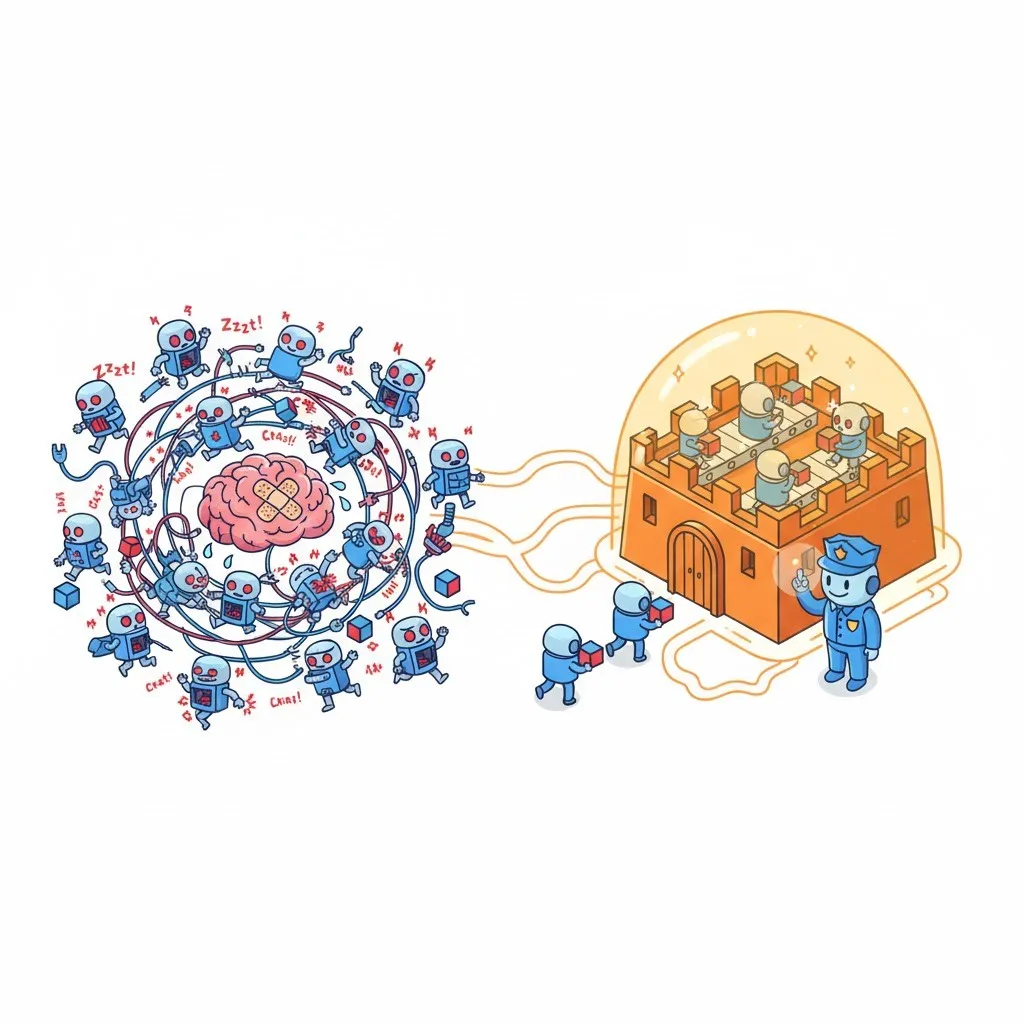
“We need AI governance guidelines.” This phrase comes up in every other CIO meeting. But what follows is usually a 50-page document full of buzzwords that nobody reads and that doesn’t work in practice. Yet AI governance isn’t an academic topic – it’s the foundation for actually being able to deploy AI systems productively.
Why Most AI Policies Fail
The Compliance Theater
Many organizations create AI policies to appease auditors or check off regulatory requirements. The result: documents that are theoretically correct but practically useless. “AI systems must be fair, transparent, and comprehensible” – nicely said, but what does that concretely mean for the developer training a model?
The Completeness Trap
The attempt to cover all conceivable AI scenarios leads to unreadable mammoth documents. Instead of clear action guidelines, legal texts emerge that confuse more than they help.
Lack of Practicality
Policies created in ivory towers ignore the reality of AI development. “All models must be explainable” sounds good, but what about deep learning models that are inherently difficult to interpret?
What AI Governance Really Must Accomplish
Building Trust
As we showed in our second article, trust is the limiting factor for AI adoption. Governance policies must concretely address:
-
How are AI decisions made comprehensible?
-
Who is responsible for what?
-
What happens when something goes wrong?
Minimizing Risks
AI systems bring new risk categories:
-
Bias and Discrimination: Unfair treatment of certain groups
-
Model Drift: Gradual deterioration of performance
-
Adversarial Attacks: Targeted manipulation of AI systems
-
Privacy Violations: Unwanted disclosure of sensitive information
Enabling Compliance
Regulated industries must be able to document and justify AI decisions. Policies must show practical ways to do this.
The Five Essential Policy Areas
1. Data Classification and Usage
What needs to be regulated:
-
Which data may be used for AI training?
-
How is sensitive data protected?
-
When is anonymization required?
Practical Example:
-
Category A (Public): Freely usable for all AI applications
-
Category B (Internal): Use after approval by data controller
-
Category C (Confidential): Only for specific, approved projects
-
Category D (Secret): No AI use without board approval
2. Model Development and Validation
What needs to be regulated:
-
What quality standards apply to training data?
-
How is bias tested and prevented?
-
What documentation is required?
Practical Example:
-
Minimum 1000 data points per category
-
Bias testing with standardized test datasets
-
Model card with scope of application and limitations
3. Deployment and Monitoring
What needs to be regulated:
-
Who may deploy models to production?
-
How is performance monitored?
-
When must a model be withdrawn?
Practical Example:
-
Staging phase with at least 30 days of test operation
-
Automatic alerts for accuracy drop > 5%
-
Rollback procedure within 2 hours
4. Responsibilities and Roles
What needs to be regulated:
-
Who is responsible for AI decisions?
-
What roles exist in the AI lifecycle?
-
How does escalation work for problems?
Practical Example:
-
Data Owner: Responsible for data quality and release
-
Model Owner: Responsible for model performance and updates
-
Business Owner: Responsible for business results and compliance
5. Incident Response and Audit
What needs to be regulated:
-
How are AI incidents handled?
-
What documentation is required for audits?
-
How is continuous improvement ensured?
Practical Example:
-
Incident categories: Bias detection, performance degradation, security breach
-
Audit trail: All model decisions traceable for 7 years
-
Quarterly review of all productive models
Industry-Specific Requirements
Financial Services
Additional requirements:
-
MaRisk-compliant model validation
-
Stress testing of AI models
-
Explainability for credit decisions
Practical Implementation:
-
Independent validation by risk management
-
Documentation of all model assumptions
-
Human override for critical decisions
Healthcare
Additional requirements:
-
Medical Device Regulation (MDR) compliance
-
Patient safety and liability
-
Clinical validation
Practical Implementation:
-
CE marking for diagnostic AI
-
Medical supervision for AI diagnoses
-
Continuous clinical monitoring
Public Sector
Additional requirements:
-
Transparency and citizen participation
-
Equal treatment and anti-discrimination protection
-
Democratic control
Practical Implementation:
-
Public consultation for critical AI systems
-
Algorithm register for transparency
-
Ombudsman office for AI complaints
Practical Implementation
Start with a Minimum Viable Policy (MVP)
Don’t begin with the perfect 100-page document. Start with:
-
5 pages of core rules
-
3 concrete use cases
-
1 pilot project for testing
Policy-as-Code
Make policies machine-readable:
```yaml
data_classification:
public:
*ai_usage: unrestrictedconfidential:
*ai_usage: approval_required*

*approver: data_protection_officer
Continuous Improvement
Policies are not static documents:
-
Quarterly review based on experience
-
Feedback loops from developers and users
-
Adaptation to new technologies and regulation
The Most Common Pitfalls
Too Restrictive
Policies that prevent any AI innovation will be circumvented or ignored. Balance between control and innovation is crucial.
Too Vague
“AI should be ethical” doesn’t help anyone. Concrete, measurable criteria are needed.
Too Static
AI technology develops quickly. Policies must be able to grow along with it.
What Actually Works
Pragmatic Approach
-
Start with critical applications
-
Learn from pilot projects
-
Expand gradually
Involving All Stakeholders
-
Developers for technical feasibility
-
Business units for business relevance
-
Legal/Compliance for regulatory requirements
-
IT Security for risk assessment
Automation Where Possible
-
Policy checks in CI/CD pipelines
-
Automatic monitoring of compliance metrics
-
Self-service tools for standard scenarios
The Strategic Dimension
AI governance isn’t just risk management – it’s an enabler for AI adoption. Good policies create trust, reduce uncertainty, and enable organizations to confidently deploy AI systems in critical areas.
Bad governance prevents AI innovation. Good governance enables it.
The question isn’t whether you need AI governance – the question is whether your policies help you or stand in your way. The time for academic discussions is over. You need policies that work in practice.
This is the fifth part of our series on AI integration beyond pilot projects. Next week: Why the AI features of your existing software aren’t sufficient and when you need standalone solutions.