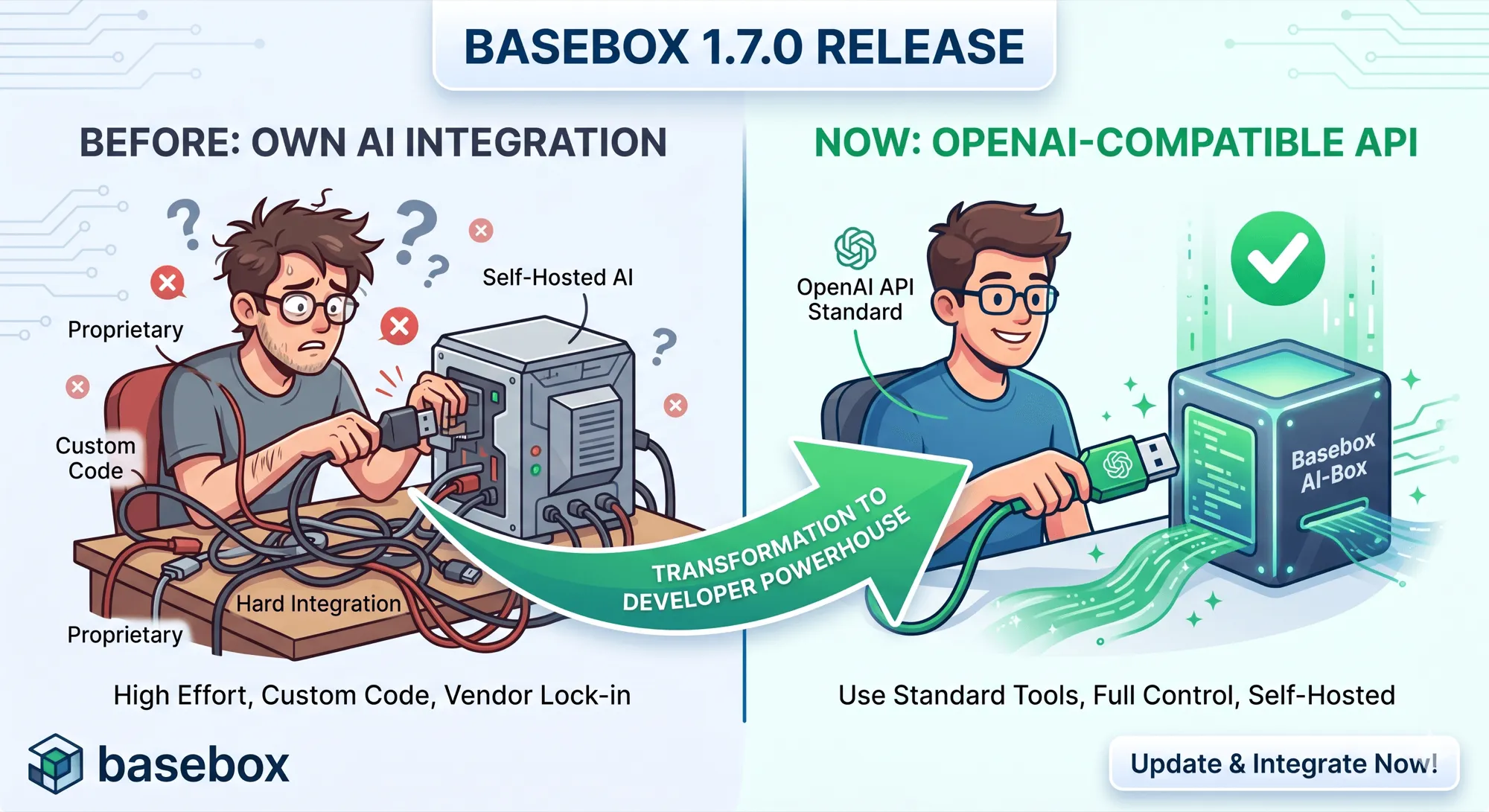
basebox 1.7.0 extends the Secure AI Stack with an OpenAI-compatible API. This simplifies the integration of self-hosted AI into existing systems—without transferring critical data outside your infrastructure.
Organizations can use AI while maintaining control over data, deployment, and compliance.
Why Integration Was a Challenge
Many AI tools, frameworks, and development environments are built around the OpenAI API standard.
For organizations operating their own infrastructure, this resulted in:
-
additional integration layers
-
adaptation of established workflows
-
increased effort for implementation and maintenance
This leads to higher development effort, longer integration cycles, and increased operational costs.
Who This Is Relevant For
This extension is designed for organizations working with critical data:
-
healthcare
-
public sector
-
financial services
-
critical infrastructure
Typical requirements:
-
no transfer of sensitive data to external services
-
compliance with regulatory frameworks (e.g. GDPR, ISO 27001)
-
operation in controlled environments (on-premises, air-gapped, private cloud)
OpenAI-Compatible API: Standard Instead of Custom Integration
With basebox 1.7.0, an OpenAI-compatible API is available.
This enables:
-
direct use of existing libraries and SDKs
-
integration into development environments without changing application logic
-
reuse of established tutorials and implementations
Supported core functions:
-
chat completions
-
streaming
-
tool calls
-
model discovery
Integration into Established Development Environments
The API is compatible with tools and workflows based on the OpenAI standard.
Typical use cases:
-
integration into IDEs
-
development of custom applications using existing SDKs
-
automation of processes with AI functionality
Integration effort is reduced to configuration instead of development.
Infrastructure Remains Unchanged
The OpenAI-compatible API extends the existing architecture.
Key aspects:
-
the GraphQL API remains fully available
-
no migration of current applications required
-
both interfaces access the same infrastructure
Organizations can continue using existing integrations while adopting standardized interfaces.
Test the API via Swagger UI
The integrated Swagger UI (/v1/api/docs) provides direct access to the API.
Functions:
-
execute API requests in the browser
-
access configured models
-
verify authentication and responses
-
debug integrations
The documentation is generated from the running instance and reflects the actual system configuration.
Administration and Communication
Message of the Day
Administrators can provide centralized information:
-
maintenance windows
-
new features
-
internal updates
Properties:
-
visible to all users
-
time-controlled
-
multilingual
Group Management
User and permission management has been adjusted:
-
direct group editing
-
live search
-
immediate application of changes
-
clear overview of structures
Optimized for Mobile Use
basebox is usable on mobile devices:
-
stable chat functionality
-
optimized input
-
adapted navigation
Security and Compliance
basebox is designed for environments handling critical data.
Enhancements in 1.7.0:
-
automated security scanning (Trivy)
-
updated identity management (Keycloak 26.5.6)
-
transactional database migrations with rollback
These measures reduce operational risk and support compliance requirements.
Getting Started
The API can be used in a few steps:
-
create an API token
-
test access via Swagger UI (
/v1/api/docs) -
integrate using OpenAI-compatible libraries
Conclusion
basebox 1.7.0 reduces integration effort and operational costs for self-hosted AI.
Organizations can use established standards while maintaining:
-
control over data
-
compliance with regulations
-
independence from hyperscalers
Access the documentation and test the API directly via /v1/api/docs on your basebox instance.